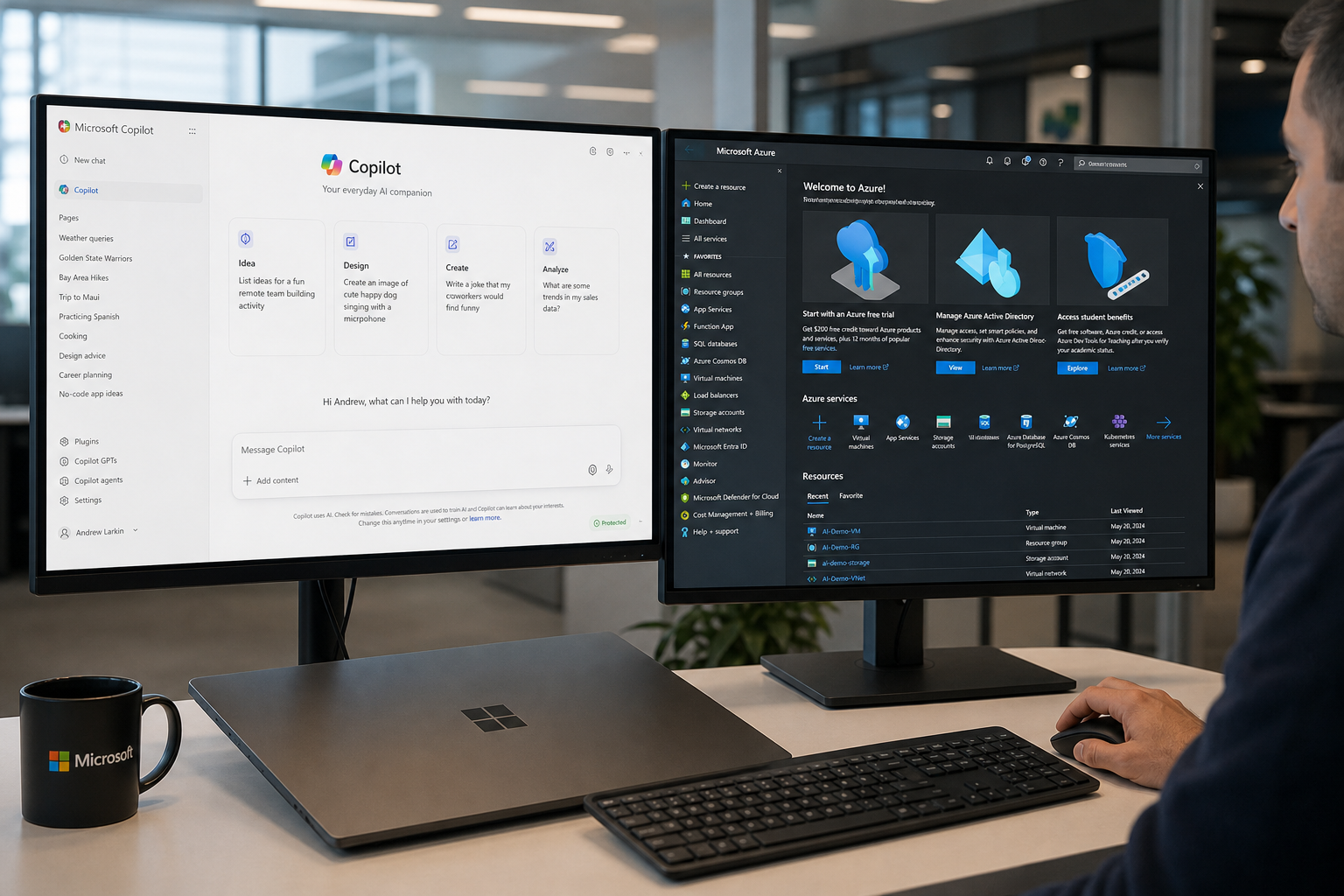
Microsoft’s newest AI signal isn’t a splashy model launch or a surprise keynote. A late-May Microsoft AI Update recap instead points to something more practical: the company keeps pushing AI into Azure, Copilot, and developer tools at the same time. That’s less dramatic than a benchmark race, but it may matter more to the people who actually ship software.
Microsoft wants AI to become a normal layer inside work software, not a separate destination users visit once in a while.
The update, posted in late May and framed as a May 2026 Microsoft AI recap, summarizes recent product releases and feature changes across Azure AI, Copilot integrations, and developer tooling, according to the available source material. Recent search results surfaced few formal AI press releases from the past few days, so the recap stands out as the freshest consolidated view of Microsoft’s AI product direction over the past week or so. It doesn’t read like a single breaking announcement. Instead, it shows Microsoft using a steady release cadence to make AI features show up across the places companies already pay for.
That pattern matters because Microsoft doesn’t need every AI update to arrive as a new model name. The company can move the market by connecting AI assistants to cloud infrastructure, office workflows, and coding environments that already sit inside corporate IT budgets. Here’s the thing: Azure AI gives Microsoft the enterprise cloud base, Copilot gives it the user-facing assistant brand, and developer tooling gives it a path into the software teams that decide what gets built next.
For users, the near-term change looks less like science fiction and more like fewer empty text boxes. Copilot features increasingly appear where people write documents, manage email, prepare presentations, search internal data, and coordinate tasks. For developers, Microsoft’s emphasis on tooling means AI can sit closer to build systems, code editors, application templates, and cloud deployment flows. So why does a recap matter? Because in enterprise software, repeated small updates often reshape daily work faster than one flashy demo.
The business impact lands first in IT departments and product teams. Companies already running Microsoft 365, GitHub-linked workflows, or Azure services can adopt AI features without ripping out their existing stack. But that convenience also raises the bar for rivals, since Microsoft can bundle, cross-sell, and expose AI functions inside tools that workers already open each morning. The catch? Buyers will judge these features by reliability, governance, cost, and admin control, not by whether a demo looks clever on stage.
Technically, the recap points to three connected surfaces: Azure AI, Copilot integrations, and developer tooling. Azure AI handles the cloud side, including the services enterprises use to build, host, manage, and connect AI functions. Copilot integrations pull those functions toward productivity workflows, where assistants can help with writing, summarizing, planning, and task coordination. Developer tooling closes the loop by giving builders ways to add AI into software projects and business processes without treating the model as a standalone product.
Worth noting: the available source material doesn’t include a direct quote from a Microsoft executive, and it doesn’t identify one single flagship feature as the headline. That limits how far anyone should push the claim. Still, the absence of a formal press-release moment tells its own story. Microsoft appears to prefer a rolling update model for AI, where customers discover improvements through product channels, ecosystem recaps, and feature documentation rather than one-off announcements.
Competitively, that strategy fits the current AI race better than it might have a year ago. OpenAI, Google, Anthropic, and Microsoft all compete on model quality, but enterprise adoption now depends just as much on workflow access, permissioning, data connections, and developer reach. Microsoft has a structural advantage because it controls major workplace surfaces through Office, Teams, Windows, Azure, GitHub, and the Copilot brand. And when AI features appear across that stack, Microsoft can turn distribution into product gravity.
The May update shows Microsoft’s AI plan settling into a clear rhythm: ship across cloud, assistants, and developer tools, then let customers connect the pieces. That approach won’t satisfy people looking for one dramatic reveal, but it fits how enterprises actually buy software. Over the next quarter, expect Microsoft’s most important AI news to look exactly like this: incremental, deeply integrated, and hard for corporate customers to ignore once renewal season starts.
About the Author