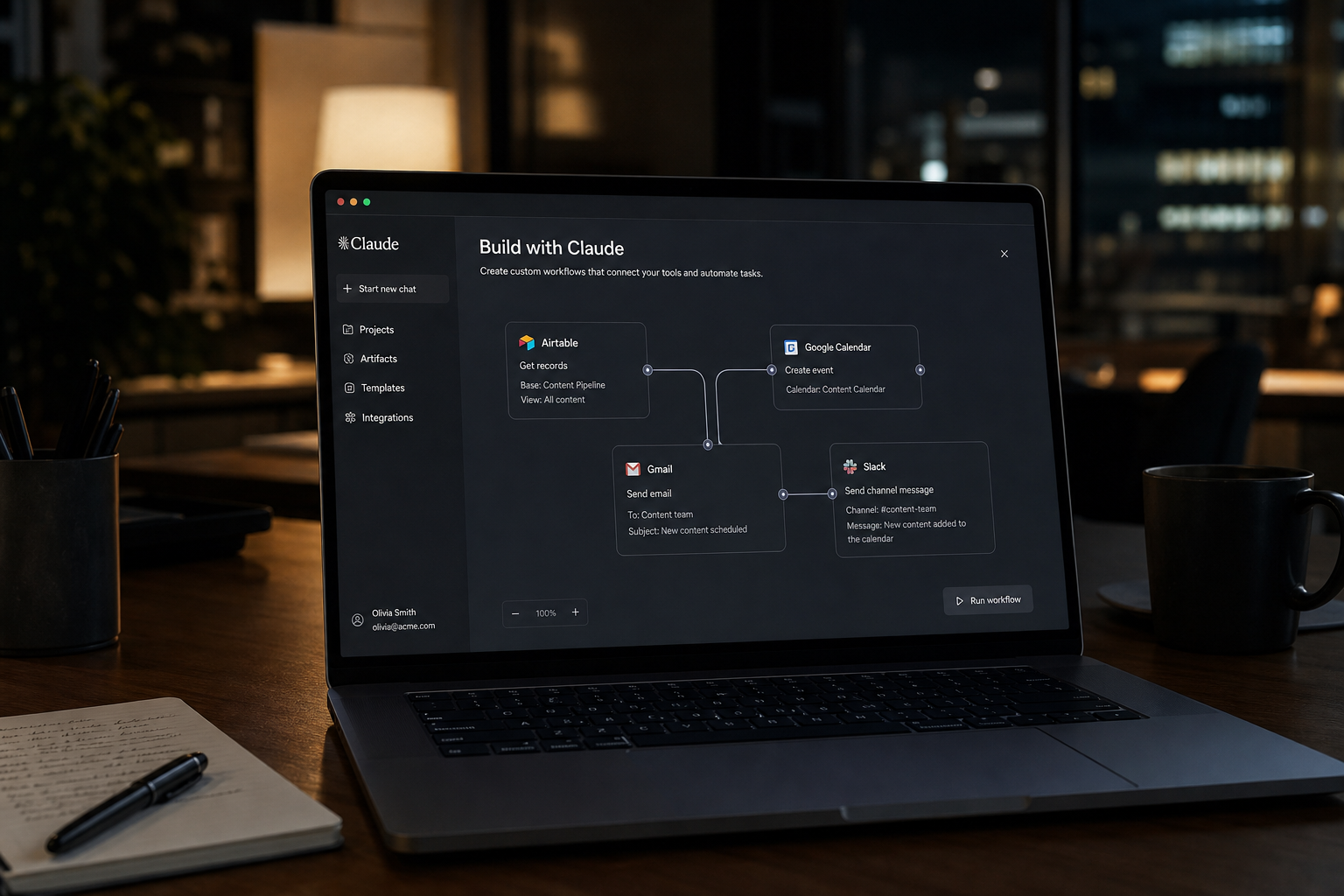
Claude’s newest wave of attention isn’t about a single benchmark score or a model-card victory lap. The fresh signal from recent AI update coverage centers on something more practical: Anthropic’s assistant acting like a builder for everyday workflows across apps such as Airtable, Google Calendar, Gmail, and Slack. That matters because the market keeps moving from chat answers toward agents that can actually arrange work.
The race now runs through the productivity stack, not just the prompt box.
A widely viewed AI walkthrough from the past few days described a “massive update” for Claude, with the emphasis falling on no-code and low-code automation rather than pure text generation. The coverage showed Claude connecting to common business tools and helping assemble workflows that would once have required a Zapier-style setup, a scripted integration, or a developer sitting nearby. It didn’t read like a formal Anthropic press release, and that distinction matters, but it did capture where user expectations have moved.
The key claim in the recent coverage says Claude can help users build automations across tools including Airtable, Google Calendar, Gmail, and Slack. In practice, that means users could ask the assistant to coordinate data, messages, schedules, and follow-ups across the services where teams already spend the day. Here’s the thing: the assistant doesn’t need to become a full software platform to change behavior. It only needs to remove enough setup friction that non-technical staff start asking Claude to assemble the workflow before they ask a human operations team.
For developers and operators, the shift cuts both ways. Claude-style workflow building can shrink the backlog of small internal requests, especially the brittle tasks that live between spreadsheets, calendars, inboxes, and team chat. But it also raises the bar for governance, testing, and auditability because an automation that sends the wrong email, moves the wrong record, or schedules the wrong meeting can create real business cost. If Claude can connect the inbox, calendar, database, and chat room from a single instruction, what counts as an app?
The technical depth sits in the orchestration layer, not only in the model’s language skill. Tool-use systems must parse the user’s intent, select the right service, map fields correctly, handle authentication, and decide when to ask for confirmation before taking action. They also need to recover from partial failure, because Gmail, Slack, Google Calendar, and Airtable don’t behave like one neat database. The hard part isn’t writing a friendly response; the hard part involves maintaining state across services and avoiding a quiet mistake that compounds over a full workflow.
The recent coverage also points to a broader change in how people evaluate assistants. Users used to ask whether a model could draft a better email or summarize a longer document. Now they ask whether it can turn that summary into a calendar invite, a Slack update, a CRM note, and a task assignment without forcing the user to copy text between tabs. The catch? Public demos often show the clean path. Real companies run messy permission structures, duplicate records, naming conventions, and approval chains that punish any system that guesses too confidently.
Reactions around this kind of Claude update have split along familiar lines. Enthusiasts see a path toward useful personal agents that handle routine coordination without code, and they point to app-to-app automation as one of the first places AI can save visible time. Skeptics focus on reliability and liability, especially when an assistant can touch communication channels and business data. Both sides have a point, but the skepticism no longer centers on whether models can understand instructions. It centers on whether companies can trust them with action.
Anthropic also faces a crowded fight. Microsoft keeps pushing Copilot deeper into Office, Azure AI, and developer tools, which gives it distribution inside companies that already pay for Microsoft 365. Google has the same advantage across Workspace, Gmail, Calendar, and its developer products. OpenAI has ChatGPT’s huge consumer mindshare and a growing appetite for tool use. Claude’s opening sits in the perception that Anthropic optimizes for careful reasoning and enterprise trust, but that edge won’t matter unless the assistant can operate inside the apps where work actually happens.
This is why the no-code angle deserves attention even without a major formal launch document. The next phase of AI adoption won’t hinge on whether a chatbot sounds smarter in a vacuum. It will hinge on whether assistants can build, run, and explain small workflows that save twenty minutes at a time. Claude’s latest burst of attention shows the market’s center of gravity moving toward agentic work, and Anthropic will need to make reliability its headline feature if it wants those demos to become daily enterprise habits.
About the Author