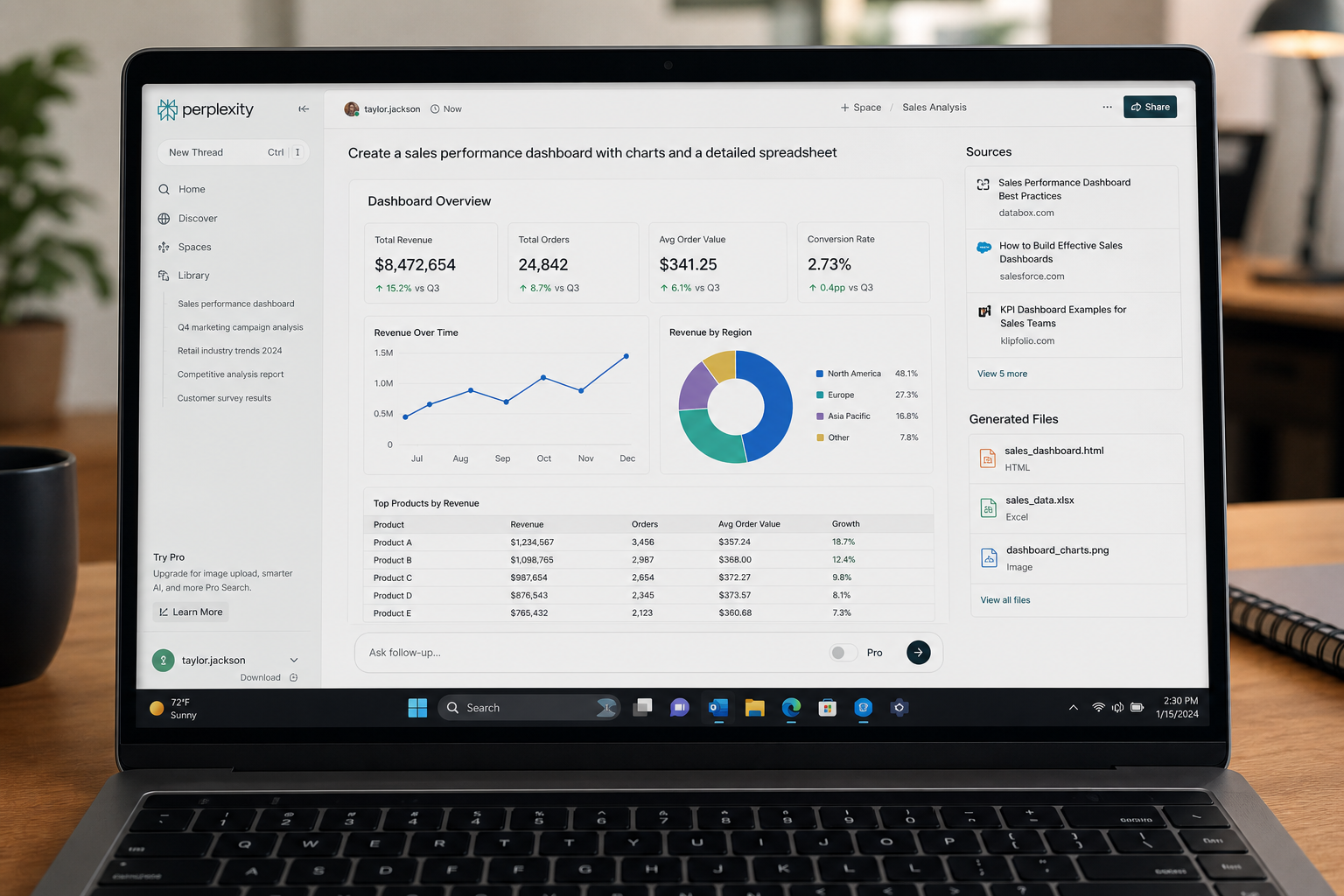
Perplexity now wants its AI search engine to make spreadsheets, dashboards, reports, and small web apps instead of just answering questions. The company’s new Labs feature pushes Perplexity Pro beyond fast research and into finished work products that users can download, inspect, and share.
That turns one of the most popular AI answer apps into a direct workplace tool, not just a search alternative.
Perplexity introduced Labs as a new capability for paying Pro subscribers, giving users a way to start with a prompt and end with a more complete deliverable. Instead of asking the app to summarize a market, explain a topic, or compare products, users can ask it to build something around the answer: a financial model, a research brief, an interactive dashboard, or a lightweight internal app. The company frames the update as a step from information retrieval into project execution, which matters because many AI apps still stall at the draft stage.
The feature sits inside Perplexity’s existing product rather than launching as a separate app. A user can describe the project in natural language, and Labs can take more time than a normal answer to plan, search, write code, generate charts, organize files, and assemble the result. Perplexity says Labs can produce reports, spreadsheets, dashboards, and simple web apps, with generated files collected for the user after the task completes. That file-first workflow makes the update especially relevant for analysts, founders, students, marketers, and anyone who spends hours converting research into a presentable artifact.
Here’s the thing: AI app competition has moved from who gives the cleanest answer to who can finish the most annoying middle step. For users, that means less copying from chat windows into Google Sheets, Notion, PowerPoint, or a code editor. For companies, it means Perplexity can pitch itself as a research assistant that also makes usable assets, which could help justify the Pro subscription for teams that already pay for ChatGPT, Claude, Gemini, or Copilot. But it also raises the bar for trust, because a polished dashboard can hide weak assumptions more easily than a plain answer can.
Labs works by combining several tool types behind one prompt. Perplexity says the system can browse the web deeply, run code, create charts, generate images, and organize outputs into files. The company has described Labs tasks as longer-running work, with the system able to spend several minutes on a project rather than returning a quick response. That extra runtime matters. A normal chatbot response can fake structure in seconds, but a spreadsheet with formulas, charts, and source-backed context needs planning and execution. The catch? Users still need to check sources, calculations, and generated code before treating the output as final.
This is where the best AI apps are headed.
Perplexity’s own messaging focuses on completed projects, and early user interest reflects a larger demand for AI that handles messy, multi-step work. Supporters will see Labs as a practical upgrade because it turns search results into something closer to a consultant’s first draft. Critics will point to the same concerns that follow every research-based AI tool: hallucinated claims, misread sources, outdated data, and unclear reasoning inside generated files. And there’s another risk for business users. When an AI system gathers public data, writes code, and produces a dashboard, the output may look authoritative even when the model made questionable choices about what to include or ignore.
Perplexity also enters a crowded fight. OpenAI has pushed ChatGPT toward tools that browse, analyze files, write code, and generate charts. Anthropic has made Claude attractive for long documents, coding tasks, and interactive artifacts. Google has tied Gemini into Workspace, search, Android, and developer tools. Microsoft continues to place Copilot inside Office, Windows, GitHub, and enterprise workflows. Yet Perplexity still has a clear angle: it started with answer search, citations, and fast research. Labs builds on that identity by letting the app turn sourced investigation into a package of files instead of a chat transcript.
The bigger story isn’t that Perplexity added another AI mode. It’s that consumer AI apps now compete on output formats, not just model quality. A user doesn’t want a clever paragraph about quarterly sales trends; they want the spreadsheet, the chart, the assumptions, and a dashboard they can send before a meeting. If Perplexity keeps Labs tied closely to citations and transparent files, it can win a useful niche among people who live between search, analysis, and presentation. The next major AI app winner won’t be the one that talks the most fluently. It’ll be the one that hands users work they can actually use by lunch.
About the Author