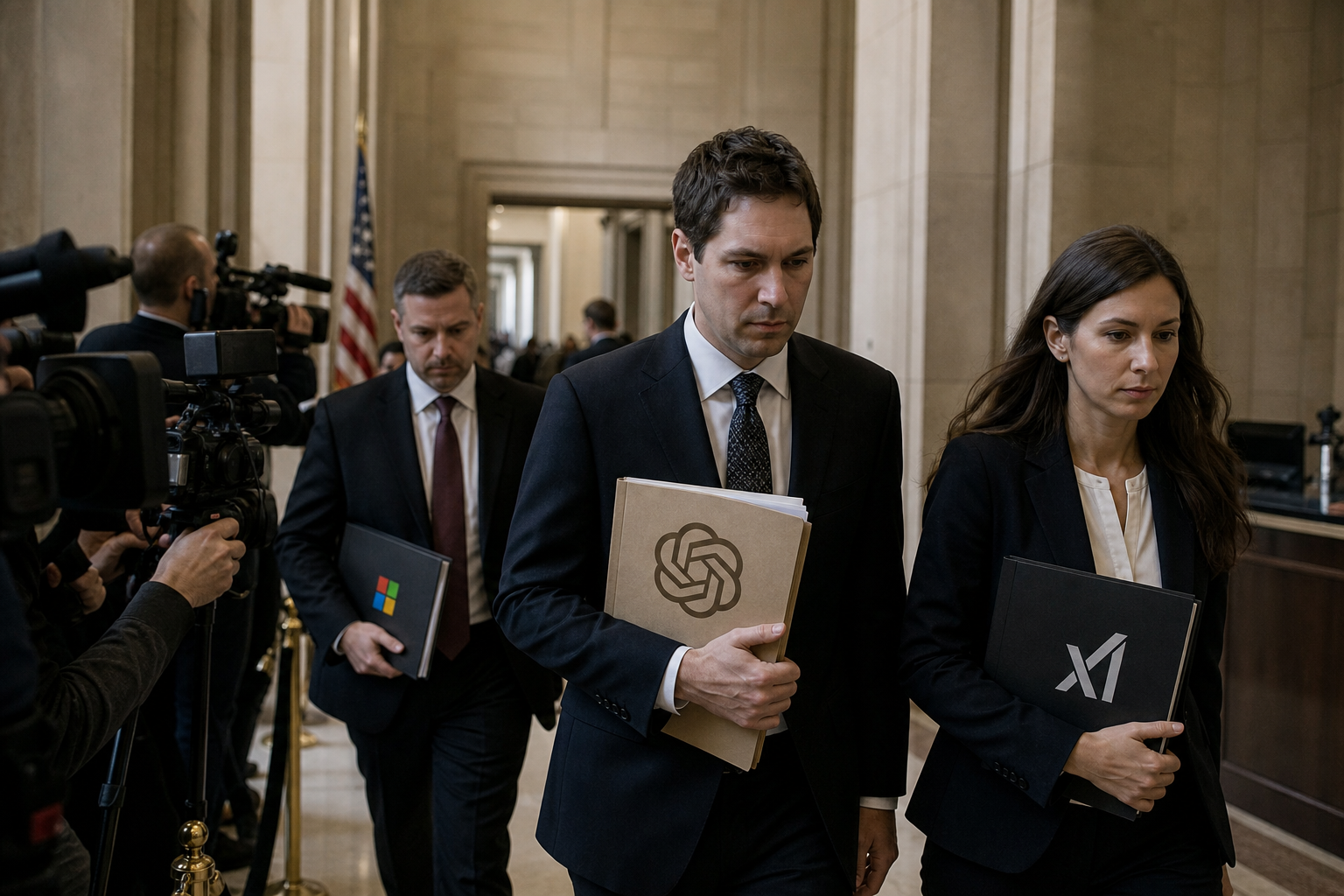
OpenAI has turned Elon Musk’s lawsuit into a two-front legal war, accusing its co-founder of using court filings, public attacks, and a $97.4 billion takeover bid to pressure the company he once helped launch. The dispute now centers on one of the AI industry’s most combustible claims: that OpenAI abandoned its founding public-interest mission after Microsoft became its dominant commercial partner. But the newest twist puts Musk himself under scrutiny.
The fight matters now because the court battle could force rare discovery into how OpenAI, Microsoft, xAI, and their executives built power around the most valuable AI systems on the market.
In an April 2025 federal court filing, OpenAI filed counterclaims against Musk and asked a judge to stop what it called “unlawful and unfair” actions. The company argued that Musk has tried to damage OpenAI after failing to gain control of it, and it tied that campaign to his competing AI venture, xAI. OpenAI’s filing followed months of litigation in California, where Musk alleged that OpenAI and chief executive Sam Altman betrayed a nonprofit mission to develop artificial general intelligence for the benefit of humanity.
Musk first sued OpenAI, Altman, and co-founder Greg Brockman in 2024, withdrew that case, then filed a revised complaint later that year. His amended lawsuit added Microsoft and claimed the companies used their partnership to dominate the generative AI market. Musk also sought a preliminary injunction to stop OpenAI’s restructuring into a more conventional for-profit model, but U.S. District Judge Yvonne Gonzalez Rogers denied that request in March 2025 while allowing the case to move toward an expedited trial. The judge said Musk had not met the legal bar for emergency relief, yet she also signaled that the public interest in the dispute justified faster handling.
For developers, researchers, and enterprise buyers, the case threatens to expose the private rules behind AI’s public promises. OpenAI built ChatGPT into a mass-market product, sold corporate access through application programming interfaces, and deepened its cloud and investment ties with Microsoft. If the litigation forces executives to produce internal messages, board materials, or deal documents, customers may learn more about how OpenAI weighed safety claims against revenue pressure. Can OpenAI still claim the public-interest halo that helped it recruit talent and trust while it fights to preserve a corporate structure built for enormous capital needs?
The technical and financial backdrop explains why both sides keep escalating. Microsoft committed more than $10 billion to OpenAI across multiple investment rounds and supplies the Azure infrastructure that trains and serves many OpenAI models. OpenAI’s capped-profit arm gave the company a way to raise huge sums while keeping a nonprofit parent in control, at least formally. Musk’s complaint attacks that arrangement as a break from OpenAI’s early stated mission, while OpenAI says the structure grew from the cost of frontier model training, compute, safety testing, and deployment. The catch? Building frontier AI now demands data centers, specialized chips, and cloud contracts that most nonprofits can’t fund on donations.
OpenAI has answered Musk’s claims with a blunt counter-narrative: Musk supported a more commercial OpenAI when he wanted to lead it. The company previously published emails that it says show Musk pushed for OpenAI to raise far more money, attach itself to Tesla, or give him greater control. Altman also publicly rejected the investor group’s $97.4 billion bid for OpenAI’s nonprofit assets with a jab on X, writing, “no thank you but we will buy twitter for $9.74 billion if you want.” Musk’s side frames the case as a fight over founding commitments; OpenAI frames it as a rival’s attempt to slow a company he couldn’t command.
The competitive context makes the courtroom drama more than founder-on-founder theater. Musk’s xAI competes directly with OpenAI through Grok, and it uses X as both distribution channel and data source. Microsoft, meanwhile, has folded OpenAI models into Copilot products across Windows, Office, GitHub, and Azure, giving OpenAI a route into enterprise software that xAI doesn’t yet match. Anthropic, Google DeepMind, Meta, Mistral, and others all chase the same customers, but OpenAI’s partnership with Microsoft remains the industry’s central power alliance. That’s why Musk’s antitrust angle matters: it targets not just OpenAI’s mission statement, but the commercial plumbing that carries AI tools into workplaces.
Here’s the thing: this lawsuit won’t settle the philosophical argument over whether a public-benefit AI lab can become a commercial giant without losing its soul, but it can settle something more concrete. Discovery will likely drag private emails, investment terms, restructuring plans, and competitive strategy into view. That record will shape how regulators, rivals, and customers judge every “safe AI for humanity” promise that comes from a company chasing frontier-scale revenue. My read is direct: the legal pressure won’t stop OpenAI’s restructuring push, but it will make the company document its mission claims with a precision that marketing language can’t satisfy.
About the Author