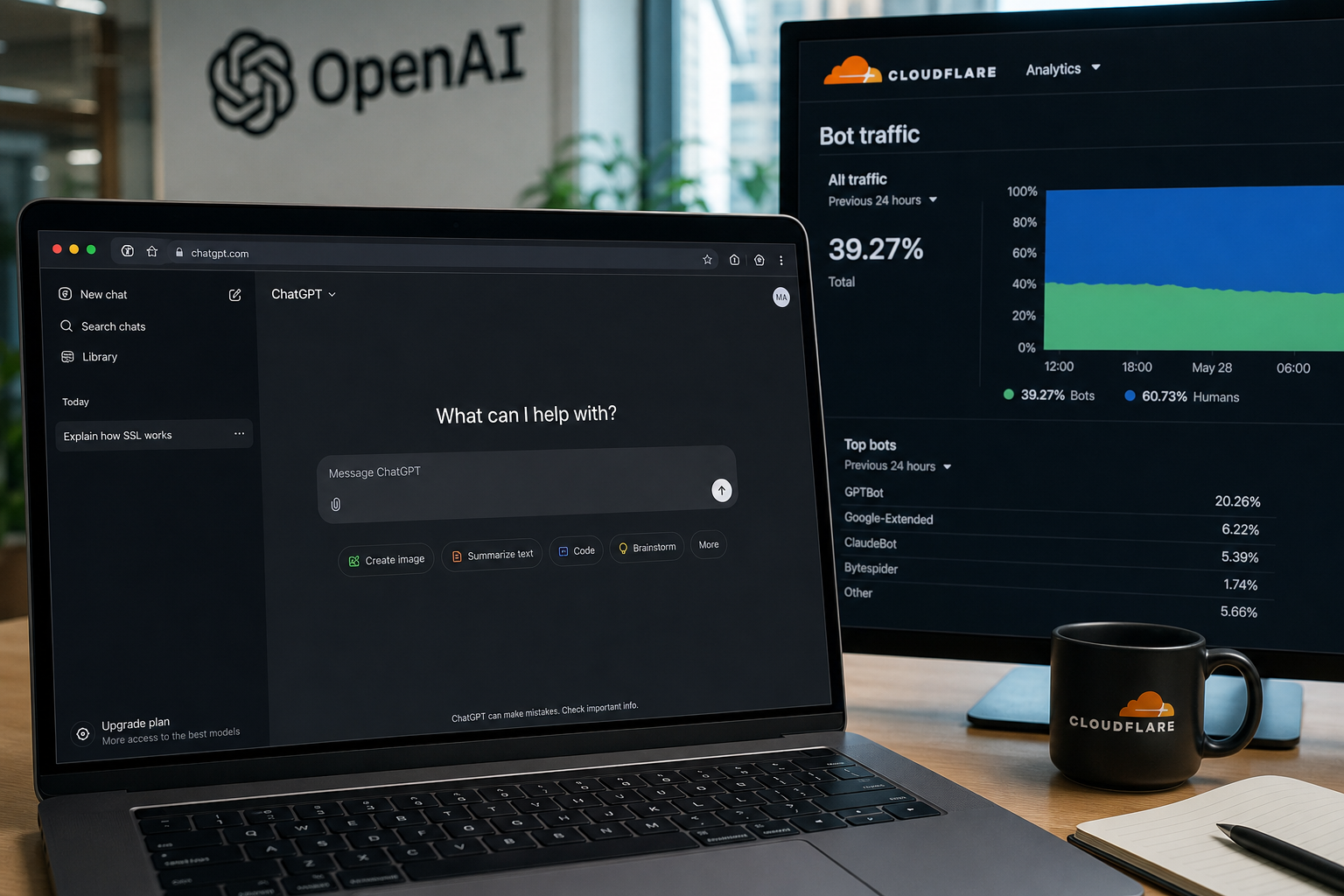
ChatGPT has reportedly crossed 1 billion monthly active users, hitting the scale in about 3.5 years. Economist Tyler Cowen cited the figure in a June 2026 talk for Swedish AI company Sana, comparing OpenAI’s speed with TikTok’s roughly five-year path to the same benchmark. Then came the darker companion number: Cowen also cited Cloudflare data showing that about 57.5% of web traffic now comes from automated systems rather than humans.
The internet’s center of gravity is shifting from people browsing pages to machines requesting, summarizing, scraping, ranking, and acting on information.
Cowen’s comments put a fresh number on something the AI industry has felt for months: ChatGPT no longer looks like a fast-growing app; it looks like basic consumer infrastructure. The 1 billion monthly active user figure, if confirmed by OpenAI, would place the service in the same usage tier as the largest social and communication platforms, but with a very different pattern of engagement. Users don’t just scroll ChatGPT. They ask it to write code, plan purchases, summarize documents, draft messages, analyze data, and make decisions that used to begin with search.
The Cloudflare traffic figure matters because it describes the same internet from the other side. If 57.5% of traffic comes from bots, crawlers, scrapers, automated agents, and other non-human requesters, publishers, platforms, retailers, and security teams can’t treat traffic volume as a simple proxy for human attention anymore. Here’s the thing: the web now has two growth curves running together — one for AI assistants gaining users, and another for automated systems consuming and shaping the web those assistants depend on.
For developers and companies, this changes product strategy fast. A billion-user ChatGPT means more users expect conversational interfaces inside work tools, commerce sites, learning products, and support channels. But the bot-traffic figure also forces teams to spend more money filtering requests, protecting content, managing API access, and measuring real demand. If more than half of web requests now come from bots, what does “user growth” even mean for the open web?
The numbers also point to a technical split that’s getting harder to ignore. ChatGPT reached the 1 billion monthly active user threshold in roughly 42 months, according to Cowen’s cited figure, while TikTok took about five years to reach a comparable scale. That compression reflects distribution advantages that older consumer apps didn’t have: direct web access, mobile apps, enterprise integrations, browser entry points, and a constant stream of model upgrades that keep users returning. The 57.5% Cloudflare figure, meanwhile, covers automated traffic broadly, not just AI model activity, so it likely includes search crawlers, monitoring tools, malicious bots, commercial scrapers, and AI-related crawlers. Still, the timing links two forces that now feed each other: models need web-scale data and services, while web services now receive a growing share of machine-originated demand.
Cowen framed the usage milestone as evidence of an “AI-intensive” internet, and that phrasing fits the moment without requiring hype. The catch? Neither OpenAI nor Cloudflare announced a joint formal release around these exact claims in the material available, so the figures should sit in the “credible signal, awaiting full primary confirmation” category. Still, Cowen’s comparison to TikTok lands because it measures adoption in terms consumer tech veterans understand. The reaction across the AI world won’t focus only on whether ChatGPT has the biggest user count; it’ll focus on whether the web can keep supplying trustworthy information when automated systems make most of the requests.
OpenAI’s competitive position looks stronger if the 1 billion figure holds. Google still owns search distribution, Microsoft embeds Copilot across Windows, Office, GitHub, and Azure, and Anthropic keeps pushing Claude deeper into work automation. Yet ChatGPT’s reported scale gives OpenAI a consumer feedback loop that most model labs can’t match. Every prompt, failed answer, retry, uploaded file, and tool use pattern tells OpenAI where users want AI to replace old software flows. That doesn’t guarantee technical superiority forever, but it gives the company a rare advantage: mass-market behavior data across personal, professional, and developer use cases.
The next fight won’t center on who can claim the flashiest model demo. It’ll center on who controls the interface between human intent and machine action. If ChatGPT has already reached 1 billion monthly users while automated systems account for 57.5% of web traffic, the AI market has entered its infrastructure phase. Search engines, publishers, SaaS vendors, and cloud providers will spend the next year rewriting their traffic rules around agent access, content licensing, and authenticated machine users. OpenAI’s reported milestone doesn’t just mark adoption; it signals that the web’s default user is no longer always human.
About the Author