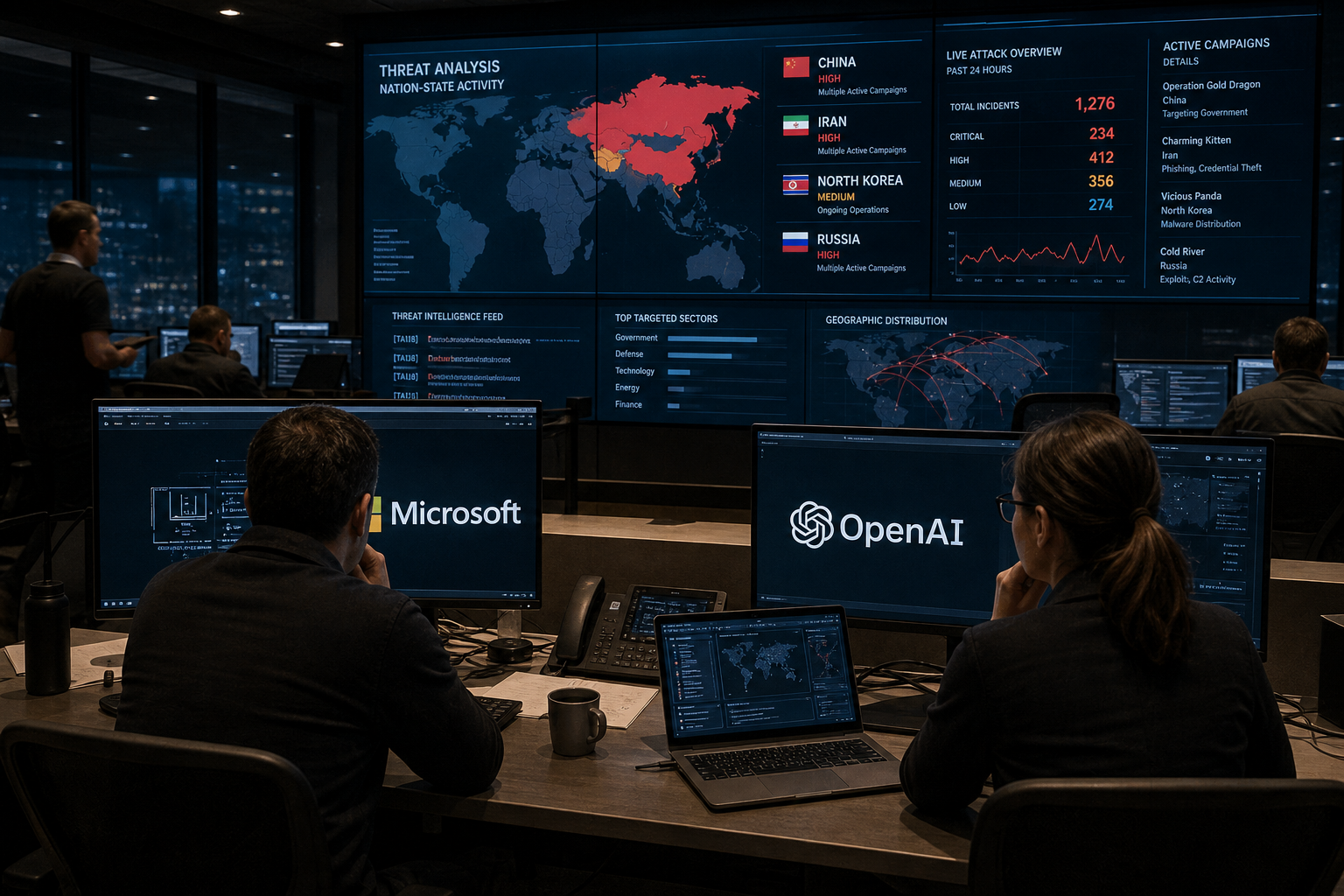
Five state-linked hacking groups from China, Iran, North Korea, and Russia have already tried to fold generative AI into real cyber operations. Microsoft and OpenAI say the activity didn’t produce a new class of AI superattack, but it did show something more practical and more worrying. The world’s best-resourced hackers are using chatbots to speed up research, scripting, translation, and phishing prep.
That matters now because AI has moved from boardroom risk slide to daily tradecraft for advanced intrusion teams.
Microsoft Threat Intelligence and OpenAI identified and shut down accounts connected to five threat actors: Forest Blizzard from Russia, Emerald Sleet from North Korea, Crimson Sandstorm from Iran, and two China-linked groups tracked as Charcoal Typhoon and Salmon Typhoon. The companies said the groups used OpenAI services for tasks that looked less like movie-style cyberwar and more like a productivity layer for intrusion work — gathering public information, drafting messages, debugging code, translating technical material, and researching targets.
The Russian group Forest Blizzard, which Microsoft links to Russia’s military intelligence service, queried models about satellite communications protocols, radar imaging, and technical scripting. Emerald Sleet, associated with North Korea, used AI to research defense experts and organizations in the Asia-Pacific region, understand public vulnerabilities, draft phishing material, and troubleshoot technical problems. Crimson Sandstorm, tied to Iran, used the tools for social engineering support, .NET development, and evasion-related research. The China-linked groups used AI for target research, translation, coding assistance, and content generation that could support reconnaissance or lure-building.
Here’s the thing: Microsoft didn’t claim that these actors used OpenAI’s models to launch a fully automated breach. Instead, the report lands in a more credible zone. Attackers don’t need AI to invent magic malware when they can use it to cut hours from the boring parts of an operation. Reconnaissance, first-draft phishing, log parsing, command syntax, and vulnerability comprehension all consume time. If elite hacking units only need an AI assistant for the dull work, how much faster does the rest of the attack chain become?
The technical pattern matters because it shows where defenses need to tighten. The activity centered on natural-language work and small technical assists rather than autonomous exploitation. Microsoft described queries involving regular expressions, file manipulation, multiprocessing, technical translation, public vulnerability research, and software troubleshooting. That mix points to an AI threat model built around acceleration, not replacement. A junior operator can ask for scripting help. A linguist can polish a spear-phishing lure. A researcher can condense public documentation about a target sector. None of that requires the model to create a zero-day exploit, and that’s exactly why it scales.
The companies also tried to draw a line between hype and observed reality. Microsoft said it had not identified significant attacks using the large language models it monitors closely, a careful phrase that avoids both panic and complacency. OpenAI said it terminated accounts associated with the activity and continues to build detection systems around abusive behavior. Still, critics in the security community will see the admission as confirmation that voluntary platform controls can’t carry the load alone. Attackers can move between providers, open fresh accounts, and test prompts in ways that look harmless until analysts connect them to a campaign.
Microsoft has a direct competitive reason to get this right. The company sells Security Copilot into the same market that worries about AI-assisted intrusions, and it wants CISOs to trust AI as a defensive tool rather than reject it as an attacker advantage. Google has pushed Gemini into security operations through Mandiant and Chronicle, CrowdStrike has marketed Charlotte AI for analyst workflows, and Palo Alto Networks has wrapped AI features into its security platforms. But the Microsoft-OpenAI report gives Redmond a sharper message: the same model class that helps defenders summarize alerts can help operators clean up phishing text or write small scripts.
Worth noting: the report also shifts the AI security debate away from the wrong benchmark. Many public arguments still focus on whether chatbots can produce dangerous malware from scratch. The more immediate risk sits lower on the stack. AI can raise the floor for mediocre attackers and raise the tempo for skilled ones. That means defenders should watch for AI-shaped behavior in identity abuse, social engineering cadence, translation quality, and rapid tooling changes, not just novel payloads.
The next phase won’t look like a chatbot pressing a big red breach button. It will look like faster operators, cleaner lures, broader target research, and cheaper experimentation across every stage before exploitation. Microsoft and OpenAI have named the early pattern clearly, and security teams that treat generative AI as an operational accelerator — for both sides — will spot the next wave sooner than teams waiting for science fiction to arrive.
About the Author