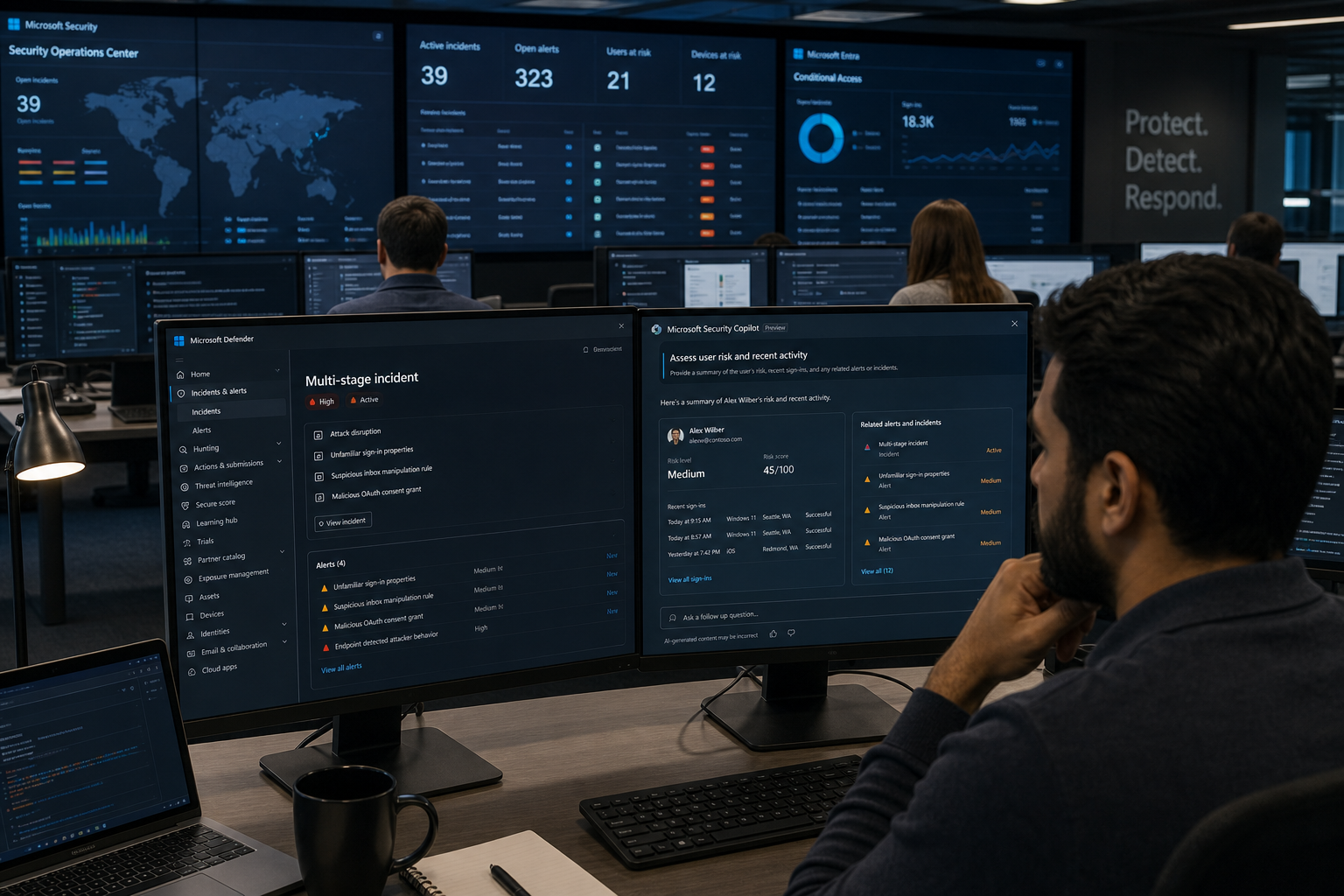
Microsoft has turned Security Copilot into something closer to an AI operations layer than a chatbot, adding agent-style systems that can take on repetitive security work across phishing, identity, data protection, and threat response. The company introduced a set of Microsoft-built agents alongside partner agents from firms including OneTrust, Aviatrix, BlueVoyant, Tanium, and Fletch. But the real shift sits in the workflow: Microsoft wants AI to move from answering analyst questions to handling pieces of the queue before a human even opens a ticket.
That lands at a moment when security teams don’t need more dashboards — they need fewer unresolved alerts.
Microsoft framed the update around Security Copilot, its generative AI product for security operations, and positioned the new agents as task-specific assistants that can act inside the company’s security stack. The lineup targets jobs that consume hours inside corporate security teams, including phishing triage, alert review, conditional access tuning, vulnerability remediation, data security investigation, and policy management. And because Microsoft owns Defender, Entra, Purview, Intune, and Sentinel, it can place these agents close to the systems where many enterprise incidents already appear. Here’s the thing: that distribution gives Microsoft a huge advantage over AI security startups that need customers to connect everything manually.
The phishing triage agent shows the clearest near-term use case. Instead of asking an analyst to review every suspicious email report, the agent can inspect signals, sort probable attacks from noise, and recommend or start a response path inside the Microsoft environment. Other agents focus on identity risk and data protection, areas where mistakes can spread fast because one misconfigured access rule or exposed file store can affect thousands of users. Still, Microsoft isn’t pitching full autonomy as the default; the company continues to stress audit trails, analyst review, and policy controls around how these agents act.
For security leaders, the appeal comes from volume. Attackers already use automation to scale phishing, credential attacks, and reconnaissance, while defenders still burn time moving from console to console. If an AI agent can triage phishing faster than a human analyst, who signs off when it gets the call wrong? That question now defines the enterprise AI security race, because speed only helps if teams can trust the decision path behind it.
The technical bet centers on specialized agents rather than one general-purpose assistant. Security Copilot uses large language models with Microsoft security data, customer context, and signals from products such as Defender XDR, Microsoft Sentinel, Entra, and Purview. In practice, that means an agent can read an incident, correlate identity and endpoint events, generate a summary, and propose the next action with supporting evidence. The catch? Security teams will judge these systems on false positives, missed attacks, permission boundaries, and whether the agent explains its reasoning well enough for regulated companies to defend the decision later.
Microsoft’s own messaging leans heavily on reducing routine work, not replacing analysts. That distinction matters because cybersecurity buyers remember what happened with earlier automation tools that promised faster response but created brittle playbooks that broke when attackers changed tactics. Analysts will welcome help with repetitive alert review, but they’ll push back hard if AI creates a second queue of outputs that require as much checking as the original alerts. Vendors can sell autonomy; security teams buy accountability.
The competitive context makes this update more than a product tweak. Google has pushed Gemini into security operations through Chronicle and Mandiant, CrowdStrike has Charlotte AI inside Falcon, Palo Alto Networks has been adding AI features across Cortex and XSIAM, and startups keep pitching agentic SOC products that promise faster investigations. Microsoft doesn’t need to beat every rival model on raw reasoning alone. It needs to connect the agent to the workflow, the identity layer, the endpoint telemetry, and the compliance record, then make switching away feel expensive.
The bigger signal is clear: AI in cybersecurity is moving from analyst copilots to controlled action-takers. That doesn’t make human security teams obsolete, but it changes the job from first-pass triage toward supervision, exception handling, and policy design. Enterprises will adopt these agents first in narrow areas like phishing, vulnerability routing, and data policy checks, where high volume meets clear rules. Microsoft now has the distribution to make agentic security feel normal inside large companies, and that will pressure every cyber vendor to prove its AI can do more than write a clean incident summary.
About the Author