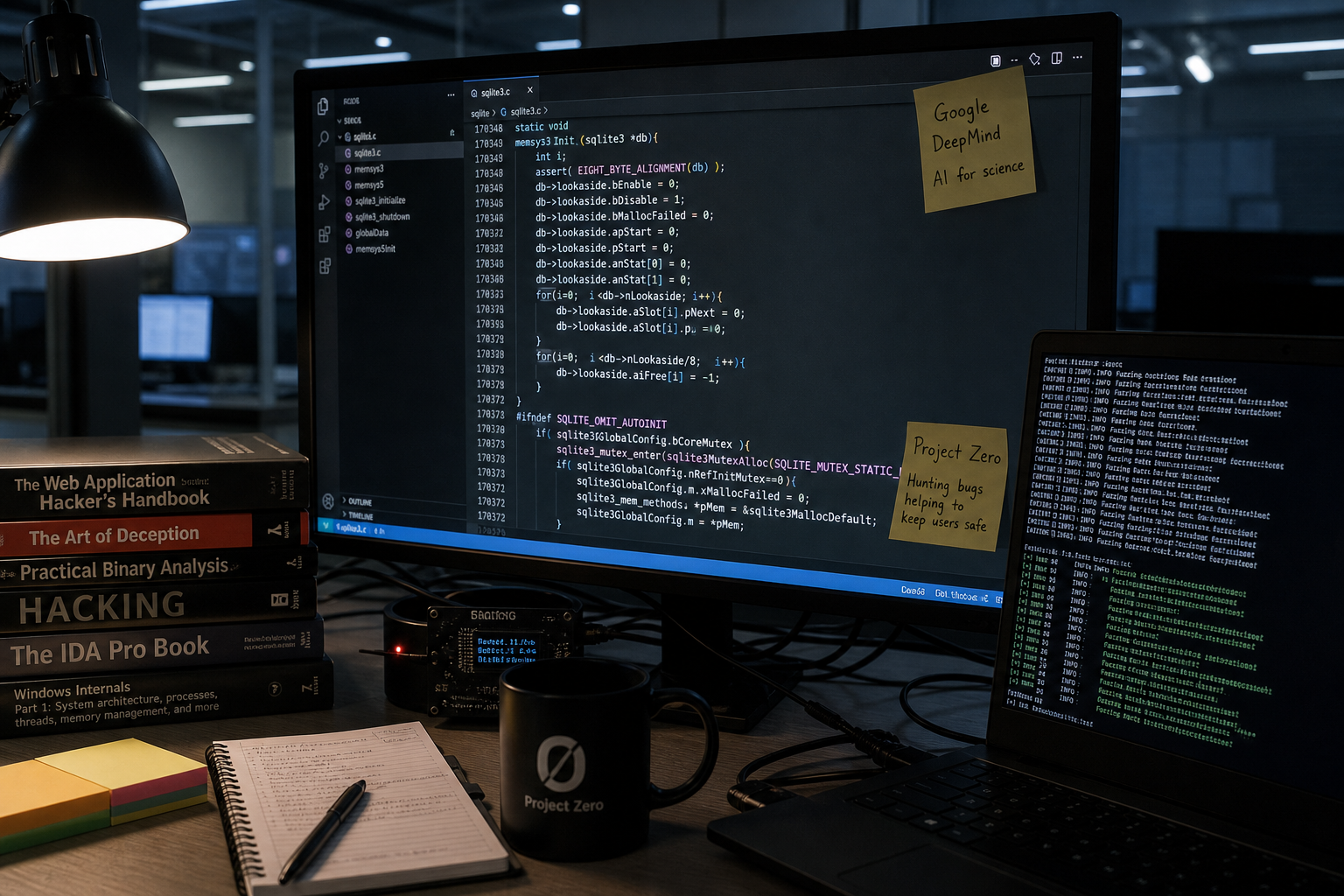
Google’s AI security project, Big Sleep, has moved from lab demo to real vulnerability hunting by identifying a flaw in SQLite before attackers could exploit it. The finding matters because SQLite sits inside phones, browsers, apps, embedded devices, and server software, making even one early catch a high-value security win.
The timing matters because defenders don’t just need faster alerts now — they need systems that can find exploitable bugs before criminals and state-backed teams do.
Google framed Big Sleep as a collaboration between Google DeepMind and Google Project Zero, two groups that sit on opposite sides of the same hard problem: building capable AI systems and proving software breaks before someone else does. The project grew out of earlier work called Project Naptime, which explored how large language models could assist vulnerability researchers by reading code, forming hypotheses, writing tests, and checking whether a suspicious pattern could turn into a real bug.
The SQLite case gave the project a sharper proof point. Google said Big Sleep found a previously unknown memory-safety issue in SQLite, and the SQLite team fixed it before the vulnerable code reached an official release. That detail matters. Security teams usually measure success after a bug ships, gets patched, receives a CVE, and triggers a long cleanup cycle across vendors. Here, the AI-assisted process caught the issue earlier in the software supply chain, where one fix can prevent a larger downstream incident.
This is the part security teams have wanted AI to handle.
For developers, Big Sleep points to a more aggressive model for defensive review, especially in codebases too large or too old for manual inspection alone. It doesn’t replace expert researchers, and Google hasn’t claimed that it can scan the entire open-source ecosystem without human direction. But it does show that AI agents can do more than summarize logs or draft phishing reports. They can interact with code, test theories, and help expose subtle flaws that would otherwise demand long stretches of specialist time.
Technically, the project matters because it treats vulnerability discovery as an iterative research workflow, not a single prompt. Big Sleep can examine source code, reason about possible fault conditions, generate test cases, and use tools to validate whether a bug can actually trigger unsafe behavior. That loop separates it from simpler AI security demos that stop at pattern matching. SQLite also makes the case more meaningful because it’s written in C, widely deployed, and security-sensitive despite its compact design. The reported issue involved memory safety, the same broad class of defect behind many high-impact exploitation chains across operating systems, browsers, and network-facing services.
Google’s security researchers have been careful about the claim. They’ve presented Big Sleep as an assistive system, not an autonomous replacement for Project Zero-style expertise. Here’s the thing: vulnerability research rewards skepticism, and the field has seen plenty of noisy tools that flood teams with false positives. Big Sleep’s credibility comes from its demonstrated handoff into a real maintainer workflow, where SQLite developers could confirm the issue and fix it before release. Still, researchers outside Google will want repeatable results across more projects, more languages, and messier enterprise code before they treat AI-driven bug hunting as a routine part of secure development.
The competitive context is already forming around this exact problem. Microsoft has pushed AI into security operations through Copilot for Security, with a focus on analyst workflows, incident response, and enterprise telemetry. OpenAI has described how threat actors use models for scripting, reconnaissance, and social engineering, while also saying it bans malicious accounts. Anthropic has highlighted model safety risks around cyber tasks. Google’s angle with Big Sleep lands in a different lane: proactive vulnerability discovery inside real code. If AI can find and help neutralize bugs before release, it attacks the economics of cybercrime at the source rather than speeding up the response after damage starts.
The catch? Attackers will chase the same capability, and the gap between defensive research agent and offensive exploit assistant can shrink fast. That creates pressure for labs to prove strong internal controls, careful disclosure, and narrow tool access. It also raises an uncomfortable question for software vendors: if AI can find these flaws earlier, how long before customers expect vendors to run these systems across every critical dependency before shipping?
Big Sleep won’t end vulnerability research as a human craft, but it will change the baseline for serious security teams. By 2026, high-risk software suppliers will treat AI-assisted code review and fuzzing as table stakes for release gates, especially in infrastructure, browsers, databases, and developer tools. Google’s SQLite example gives the industry a concrete model: use AI before the patch Tuesday clock starts, and turn bug discovery from cleanup into prevention.
About the Author