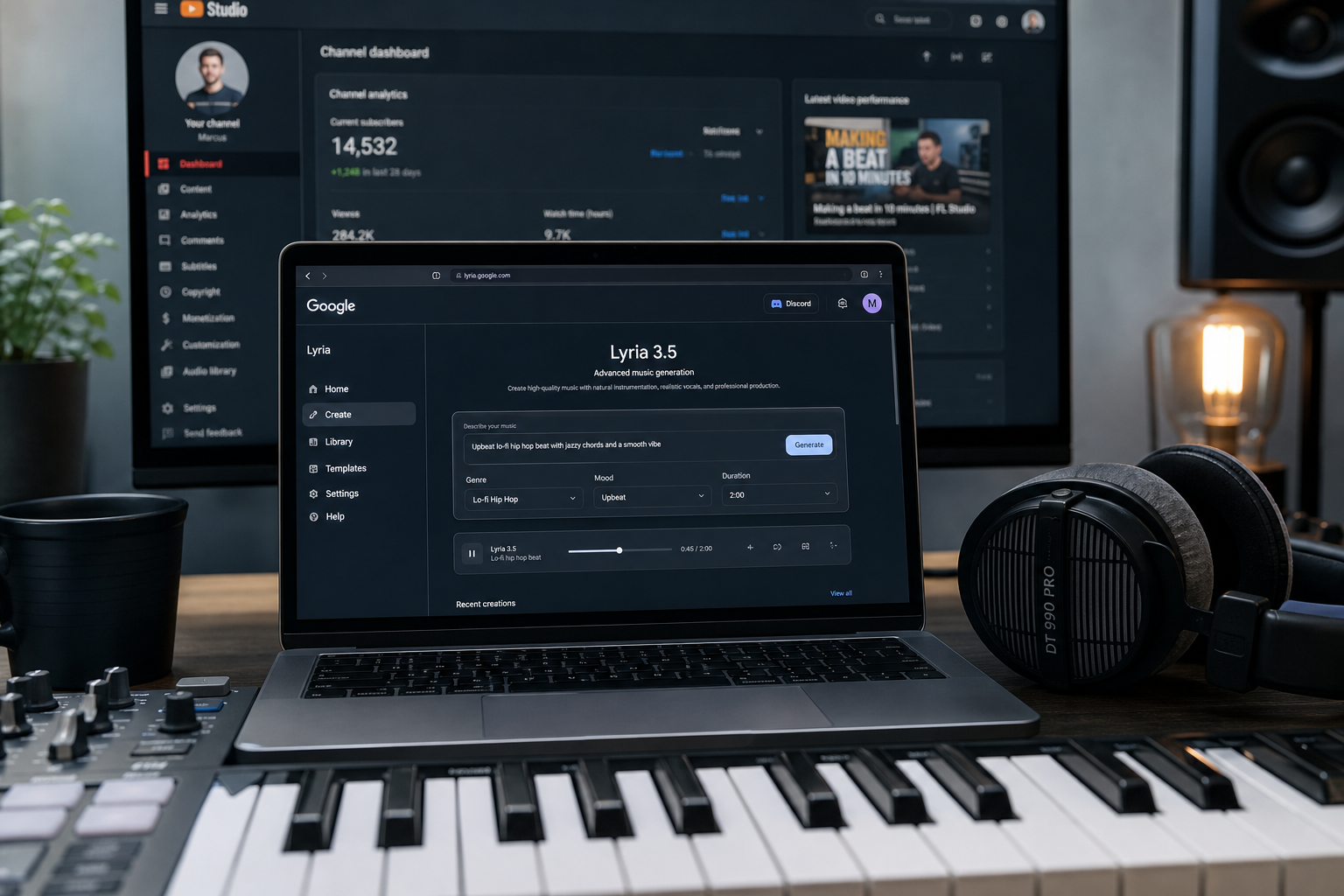
Google’s reported Lyria 3.5 release puts music generation back near the front of the AI product race, even though the available reporting still leaves key technical details unanswered. The update appeared in recent AI news tracking as a new Google music-generation model, grouped with other fast-moving releases from OpenAI, Anthropic, NVIDIA, and Google itself. But the clearest fact so far is also the most important one: this looks like a music AI story where verification matters as much as the model name.
The timing matters because AI music tools now sit directly between consumer creation, copyright fights, and platform distribution.
According to the search material supplied for this story, Google has released Lyria 3.5 for music generation. The same batch of AI news references also points to Google’s Gemini 3.8 Flash as a separate model focused on reasoning, coding, and cost efficiency, but Lyria 3.5 stands apart because it targets a different and increasingly contested category: generated music. That places Google deeper into a part of AI where demos can spread faster than documentation and where musicians, labels, app developers, and video creators all want different answers from the same model.
The reporting doesn’t include a primary Google blog post, model card, product page, pricing table, or developer documentation for Lyria 3.5. That gap doesn’t make the report false, but it does limit what anyone can responsibly say about the system today. So the safest read is narrow: recent AI news aggregation identifies Lyria 3.5 as a Google music-generation release, while the public technical record available in the search material doesn’t yet show enough detail to judge capability, rights handling, access, or commercial limits.
Here’s the thing: music generation isn’t just another creative AI feature bolted onto a chatbot. It touches training data provenance, artist likeness, publishing rights, royalty splits, platform moderation, and the economics of stock audio in one move. If Lyria 3.5 reaches creators through Google’s existing product channels, it could matter quickly for YouTube workflows, short-form video production, advertising agencies, game studios, podcast teams, and indie developers who need background tracks without booking composers for every asset. But who gets paid when a prompt produces a song that feels commercially usable?
The technical picture remains thin. The available report gives the product name, Lyria 3.5, and describes its purpose as music generation, but it doesn’t provide parameter counts, training sources, audio duration limits, latency targets, supported genres, watermarking methods, output formats, licensing terms, or safety filters. It also doesn’t provide benchmark numbers, human preference scores, or side-by-side evaluations against other music models. That absence matters because AI audio quality depends on more than catchy samples; producers need stable structure, clean stems, consistent vocals, controllable arrangement, and predictable rights terms before they’ll build repeatable workflows around a model.
Reaction will likely split along familiar lines, and the split makes sense. Creators who already use generative image and video tools will treat Lyria 3.5 as another way to speed up drafts, mood boards, and production music. Rights holders will ask harder questions, especially if Google hasn’t published clear training-data disclosures or compensation rules in the materials now circulating. Developers will care less about demo tracks and more about API access, pricing, latency, and whether the model can create variations without drifting away from a brief. That said, the current reports don’t include quotes from Google executives, artists, labels, or customers, so any strong claim about market reception would run ahead of the evidence.
Competitively, Lyria 3.5 would put Google into the same high-pressure lane as specialist AI music companies and broader model labs that treat audio as part of a multimodal stack. Suno and Udio have trained users to expect full-song generation from simple prompts, while platforms tied to video creation increasingly want music, sound effects, voice, and image generation to work together inside one editing flow. Google has a natural advantage if it connects Lyria to YouTube, Android, Workspace, or cloud developer tools. Yet that same advantage raises scrutiny, because a Google music model doesn’t enter a neutral market; it enters a market where Google already controls massive discovery, hosting, and monetization channels for music and video.
The closing read is simple: Lyria 3.5 deserves attention, but not hype without paperwork. Google can turn AI music into a serious product category if it pairs model quality with transparent rights rules, creator controls, and business terms that studios can trust. Until those details surface, Lyria 3.5 functions less like a finished market signal and more like an early warning that the next AI music fight will center on distribution, not just generation.
About the Author