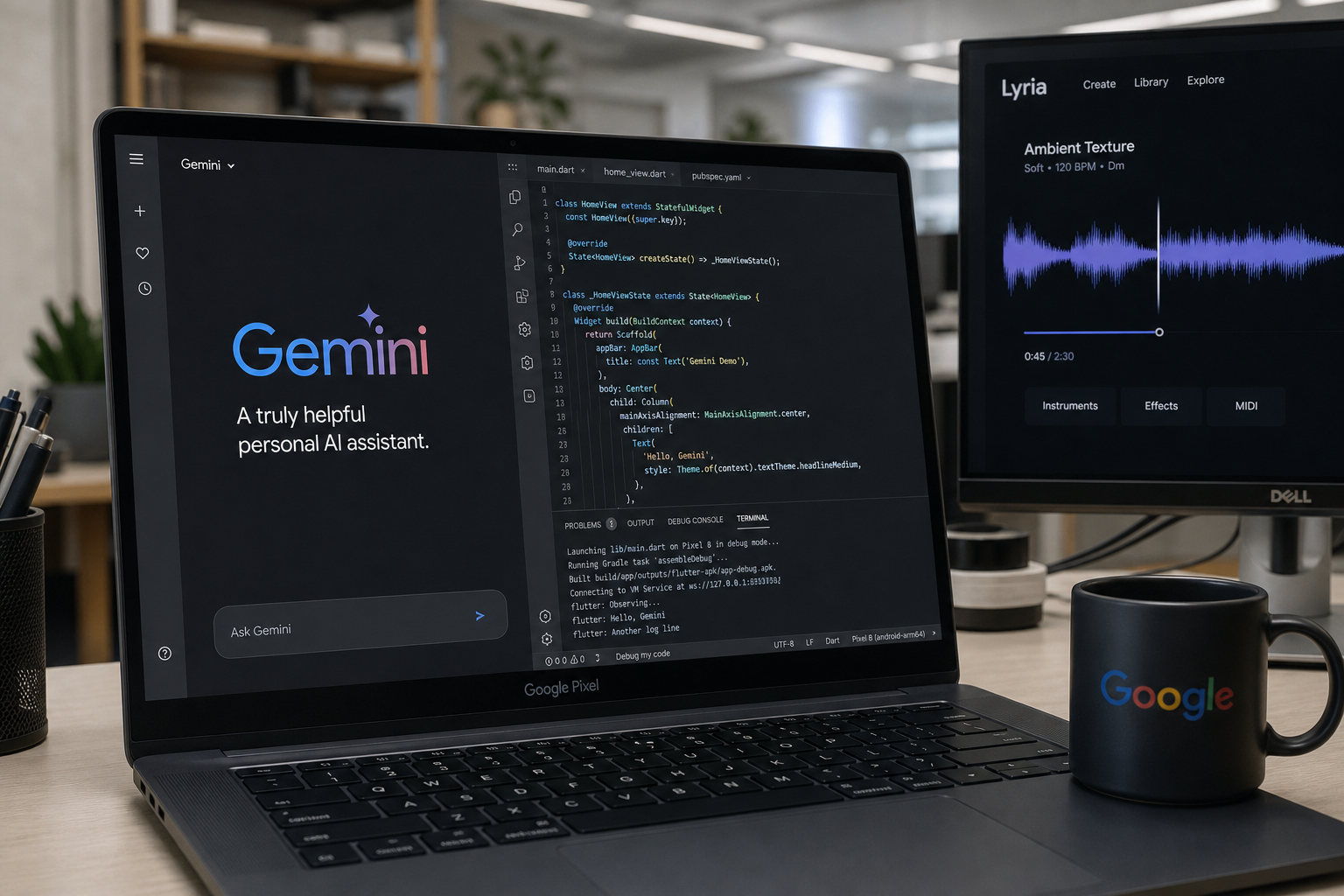
Google’s newest AI update is drawing attention because the reported model aims at the three workloads buyers now measure hardest: reasoning, coding, and cost. The supplied search results say Google released Gemini 3.8 Flash, and they also point to Lyria 3.5 for AI music generation. But the details remain thin, which makes the verification gap almost as important as the launch claim itself.
That matters now because model vendors can’t win the AI race with bigger demos alone.
According to the supplied search results, which reference items [1], [2], and [14], Google has pushed Gemini 3.8 Flash as a model focused on stronger reasoning, coding performance, and lower operating cost. The same research snapshot says Google also released Lyria 3.5, a music-generation system, placing the update across both enterprise AI and creative media. Those are two very different markets, yet Google has a reason to move on both at once: Gemini needs to defend productivity and developer use cases, while Lyria keeps pressure on audio-generation rivals.
The catch? The available material doesn’t provide primary release notes, pricing tables, benchmark sheets, or direct executive comments from Google. That doesn’t mean the update didn’t happen, but it limits what anyone can responsibly claim today. A careful reading supports one solid takeaway: Google’s reported AI push centers on efficiency and task performance rather than a single flashy consumer app. And that tells us where the next model fight sits.
For developers, a Flash-branded Gemini update matters because Google uses that line to signal speed and lower cost relative to heavier models. If Gemini 3.8 Flash improves reasoning and coding while keeping inference cheaper, teams could route more agent tasks, code review jobs, and data-analysis workflows through a faster model without paying premium-model prices every time. So what should developers do with a model report they can’t yet validate against primary release notes? They should wait for hard numbers, then test the model against their own regression suites rather than rely on vendor or aggregator claims.
The technical story lives in the phrase “reasoning, coding, and cost efficiency,” because those categories now define whether a model can run inside real software pipelines. Reasoning gains matter only when the model handles multi-step instructions without drifting. Coding gains matter only when it passes tests, edits existing repositories cleanly, and explains changes without inventing dependencies. Cost efficiency matters because enterprise AI spending has moved from experimentation budgets into finance reviews, where every token now competes with cloud compute, storage, and security spend.
The available sources also leave open how Google measured Gemini 3.8 Flash. The search summary doesn’t name benchmarks such as SWE-bench, HumanEval, MMLU-style reasoning tests, GPQA, or internal latency measurements. It also doesn’t specify context window length, input and output pricing, multimodal limits, regional availability, or whether the model has reached public API access. Without those figures, buyers can’t compare Gemini 3.8 Flash cleanly against OpenAI, Anthropic, Meta, Mistral, or Alibaba models. Worth noting: efficiency claims often look strong in demos and weaker under production traffic — especially when workloads require long context, tool calls, retries, and strict output formats.
Google’s reported Lyria 3.5 release adds another layer because music generation carries different risks than coding assistants. Audio models raise copyright, licensing, attribution, and platform-moderation questions that don’t map neatly onto text chatbots. The research snapshot gives no detail on training data, output controls, artist protections, watermarking, or commercial-use terms. Still, Google’s decision to pair a reported Gemini update with a reported music model update shows how broad its AI strategy has become: one track targets enterprise and developers; the other courts creators, media tools, and consumer-facing production.
Reaction should stay measured. The supplied results don’t include direct quotes from Google, independent benchmark labs, enterprise customers, or outside researchers, so the public record doesn’t yet support a victory lap. Analysts and engineering teams will likely treat the news as a watch item until Google posts docs, model cards, and API guidance. That said, the market won’t ignore the claim, because even a modest Gemini Flash improvement can shift routing decisions inside companies that already use Google Cloud, Workspace, Vertex AI, or Android-linked services.
Competitive pressure explains the timing. OpenAI has trained users to expect fast model upgrades inside ChatGPT and its API stack, while Anthropic has built credibility around coding and workflow reliability. Meta keeps pushing open-weight models into developer ecosystems, and smaller labs compete on price, speed, and permissive deployment. In that contest, Google doesn’t need Gemini 3.8 Flash to win every benchmark. It needs the model to look dependable, cheap enough at scale, and easy to plug into existing Google infrastructure.
The next real signal won’t come from a headline; it’ll come from developers publishing latency, pass-rate, and cost comparisons after running Gemini 3.8 Flash against production tasks. If Google confirms the reported release with clear documentation and credible benchmarks, the Flash line will become a stronger default option for high-volume AI work rather than a secondary model for cheaper queries. Until then, the smart read is simple: Google’s reported update shows the AI race moving from raw capability claims to measurable operating economics.
About the Author