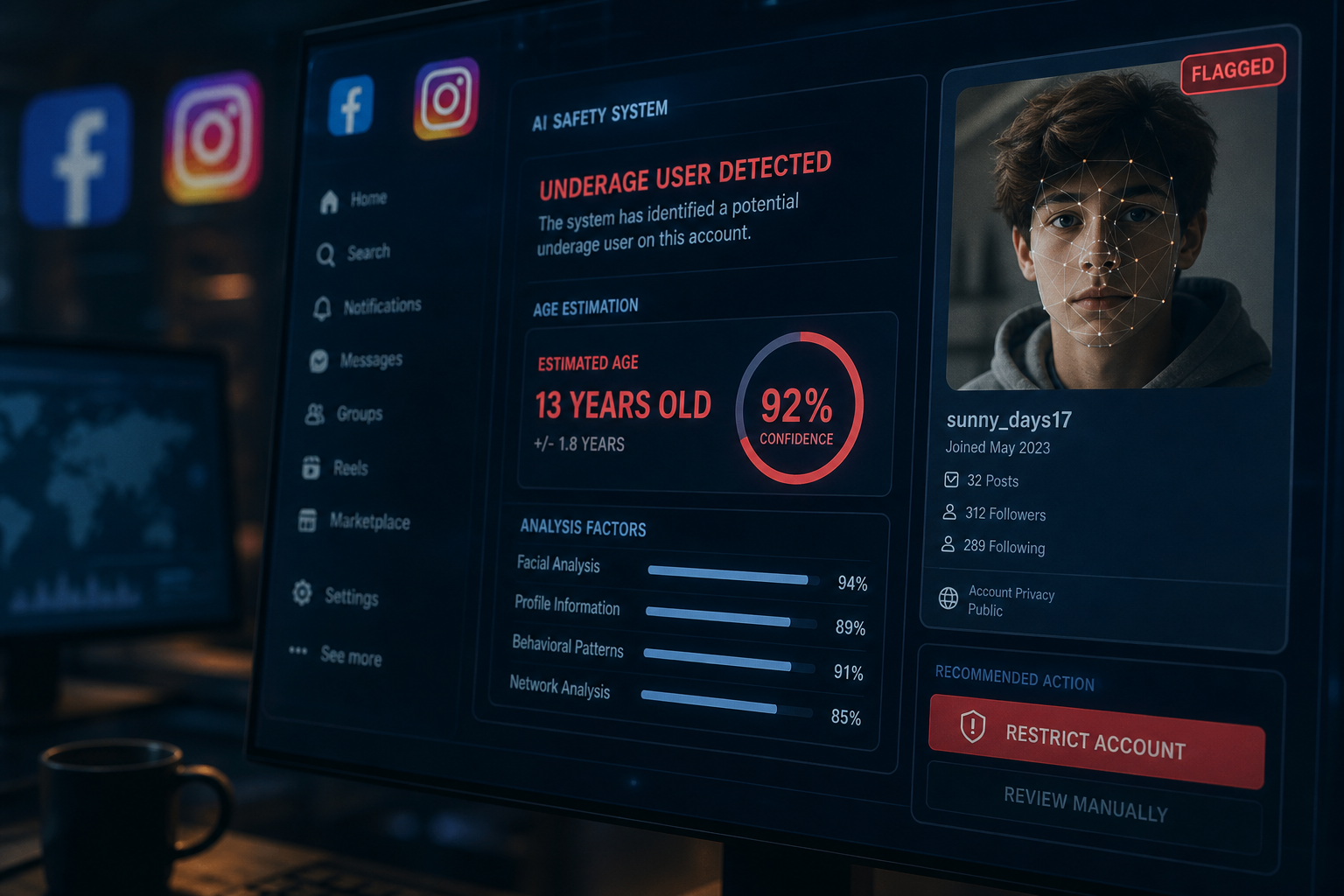
The rise of AI-powered monitoring tools marks a new chapter in online safety. Meta is deploying an AI system that can analyze photos and videos to detect underage users on platforms like Facebook and Instagram. This move comes on the heels of a $375 million child safety settlement, and it’s about to change the digital landscape for millions.
This matters now because legal pressures and parent outrage are driving tech giants to act decisively. With online safety being a pressing issue, AI’s capabilities are being harnessed like never before to protect children.
Meta’s latest tool employs computer vision to assess images for factors like bone structure and height, helping identify users under the age of 13. By launching this system, Meta hopes to curtail the presence of underage users effectively. Complementary to this measure, they are rolling out “Teen Accounts” that come with stricter controls, initially targeting users in the U.S. and Europe. Such accounts limit features such as direct messaging and visibility of certain types of content, providing a more safeguarded digital space for teens.
For many, the use of advanced AI for moderating content represents a much-needed evolution in the ever-expanding realm of social media. It’s not just about technological prowess—it’s a response to societal demands for accountability. By automating the detection process, Meta can prevent underage access more efficiently than traditional methods, which relied heavily on user reports and manual reviews.
Here’s the technical bit: AI systems like the one Meta’s deploying work by analyzing various biometric indicators in the content shared on their platforms. This is achieved through deep learning algorithms trained on vast datasets to recognize physical characteristics indicative of age. It’s similar to facial recognition technology but fine-tuned for age estimation—no small feat given the subtleties involved in such assessments.
The reactions are mixed. Advocacy groups praise the initiative as a crucial step in digital child protection, while others express concern over privacy and the potential for errors in AI judgments. Regardless, the consensus underscores a willingness to see improved safety measures online. The effectiveness of these AI tools will likely serve as a benchmark for competitors, pushing them toward similar implementations.
In terms of competition, the digital giants like Google and TikTok will surely be watching Meta’s implementation closely. Both companies have faced scrutiny over how they safeguard young users. Google, with its family suite of products, and TikTok, with its youthful demographic, may find themselves adopting or enhancing similar technologies to maintain user trust and comply with regulatory expectations.
Looking ahead, Meta’s move could set a precedent for the role AI plays in user safety across platforms. As regulations tighten and the digital world continues to intertwine with everyday life, using sophisticated AI to enforce age restrictions will likely become standard practice. It’s a development that doesn’t just cater to regulatory demands but perhaps hints at a broader future where AI routinely steps in to offer real-time solutions to complex societal challenges.
About the Author