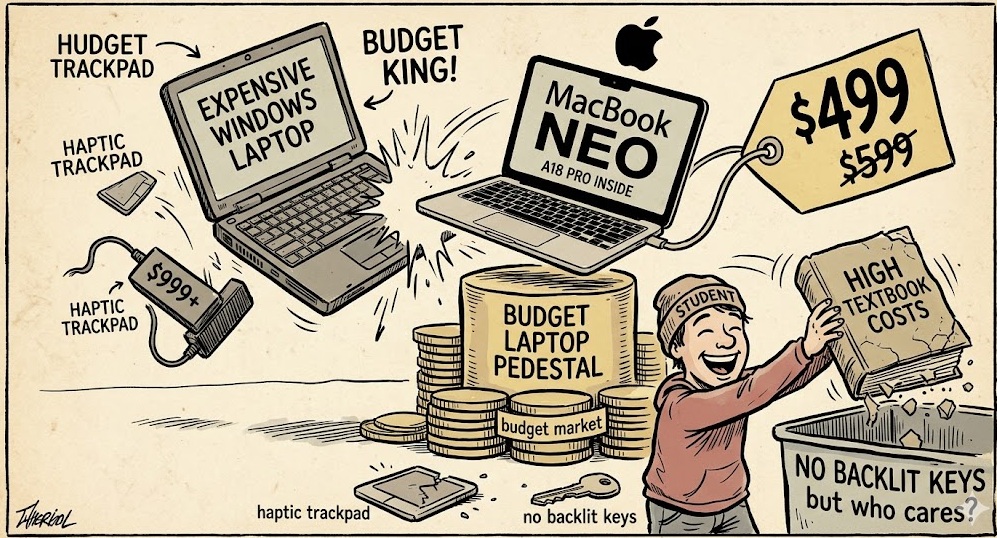
Apple announced the MacBook Neo on March 4, starting at $599 and $499 for education. It uses the A18 Pro chip from the iPhone 16 Pro instead of an M-series chip. Apple claims it is up to 50 percent faster than comparable Intel Core Ultra 5 PCs for everyday tasks and up to 3x faster for on-device AI. It has a 13-inch Liquid Retina display without a notch, 16-hour battery, 8GB unified memory, and two USB-C ports. It lacks Thunderbolt, True Tone, P3 color, and a backlit keyboard on the base model, but it is Apple’s lowest-carbon Mac.
The idea of a cheap MacBook used to be a punchline. The MacBook Neo changes that by putting an iPhone chip in a laptop body and charging $499 for students.
Apple announced it on March 4, with pre-orders that day and shipments starting March 11. It is the first Mac to run on the A18 Pro, the same processor from the iPhone 16 Pro line.
On paper it reads like a Chromebook competitor with Apple polish. You get a 13-inch Liquid Retina display at 2408 by 1506, 500 nits, and no notch, just slim iPad-style bezels.
Why it matters is simple math for schools and families. Apple says it is up to 50 percent faster than the bestselling Intel Core Ultra 5 PC for web browsing and documents, and up to three times faster for on-device AI tasks.
That speed comes with tradeoffs. There are only two USB-C ports, one limited to USB 2 speeds, no Thunderbolt, no P3 wide color, no True Tone, and the base Magic Keyboard skips backlighting. You also get 8GB of unified memory and 256GB storage to start.
To be fair, most students do not need Thunderbolt. They need something that boots fast, lasts all day, and does not lag with 20 Chrome tabs. The Neo promises 16 hours of video playback and weighs 2.7 pounds, so it fits in a backpack without complaint.
The technical detail that makes this possible is binning an A18 Pro for a fanless chassis. It sips power, runs cool, and still handles photo edits about twice as fast as Apple claims for comparable Windows laptops. It ships with macOS 26 Tahoe and Apple Intelligence features.
Apple is also pushing sustainability. The Neo uses 60 percent recycled materials, including 90 percent recycled aluminum and 100 percent recycled cobalt in the battery. That makes it the lowest-carbon Mac so far.
Early reviews from Macworld and TechSpot say single-core performance feels snappy, side-firing speakers with Spatial Audio punch above their size, and the color-matched keyboards in Silver, Indigo, Blush, and Citrus look fun in classrooms. They also note the lack of a haptic trackpad and limited external display support.
And that is the point. This is not a Pro machine in disguise. It is a deliberate play to pull buyers away from $500 Windows laptops by offering macOS, iMessage, and AirDrop at the same price.
If you live in Google Docs, Zoom, and light creative apps, the Neo makes sense. If you edit 4K video or need multiple monitors, you will hit the ceiling fast. For everyone else, Apple finally built the budget Mac people asked for.
About the Author