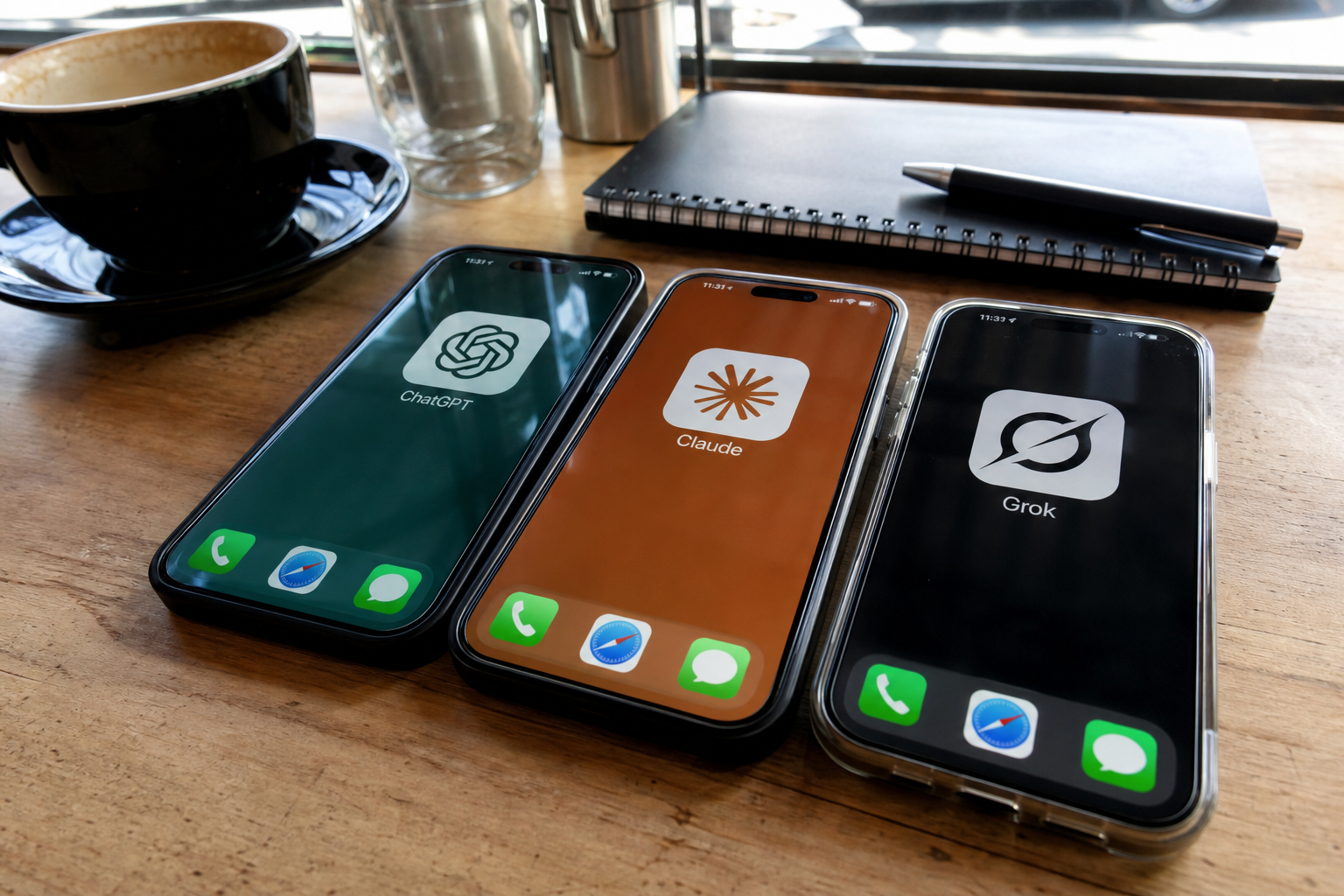
ChatGPT, Claude and Grok reportedly went down at the same time, turning a routine service hiccup into a warning shot for the AI industry. The outage item appeared in today’s technology-news roundup as one of the most closely watched AI developments, with the summary attributing the report to sources [2] and [7]. That matters because these tools no longer sit at the edge of work; they sit inside writing, coding, search, support and daily decision loops.
When three major AI assistants stumble together, the story isn’t just uptime — it’s concentration risk.
The available research summary says ChatGPT, Claude and Grok “sempat down bersamaan,” or briefly went down at the same time, drawing attention to how dependent users have become on AI infrastructure. It doesn’t provide a precise start time, outage length, geography, provider status-page text, or a confirmed root cause. That limit matters, because without those details nobody should claim a shared technical failure, a cloud-provider issue, an API routing fault, or coordinated pressure on model-serving systems.
Still, the reported overlap alone explains why the incident caught reader attention. OpenAI’s ChatGPT remains the mass-market default for many users, Anthropic’s Claude has gained a strong following among developers and knowledge workers, and xAI’s Grok has become a visible AI layer inside Elon Musk’s broader product orbit. When all three become unavailable around the same window, even briefly, users don’t experience three separate vendor problems; they experience the AI layer of the internet going soft at once.
Here’s the thing: AI outages now hit differently from a classic SaaS failure. A spreadsheet app going down blocks one task, but an AI assistant outage can break drafting, summarization, customer-service macros, coding copilots, data cleanup, meeting prep and internal search habits at the same time. What happens when the default work tool goes dark across several brands at once? Companies that quietly moved everyday tasks into AI chat interfaces have to answer that question before the next failure, not during it.
The technical pressure behind these systems also differs from older web services. Large model products depend on several moving parts: user-facing apps, authentication, rate-limit systems, safety filters, retrieval tools, model routers, GPU capacity and third-party integrations. A failure in any one layer can look like “the model is down” to a user, even if the core model weights and inference clusters still operate. The research summary doesn’t identify which layer failed for ChatGPT, Claude or Grok, so the only safe read is narrower: multiple major assistants appeared unavailable at roughly the same time, and readers treated that as a notable reliability signal.
Reactions tend to split along predictable lines, and both sides have a point. Power users see these incidents as proof that AI vendors need clearer status reporting, better failover paths and more honest communication when capacity strains. Casual users often shrug and come back later, which gives the big labs room to treat short outages as acceptable friction. But enterprise buyers don’t get that luxury. If a support workflow, sales team or engineering group builds around a hosted AI assistant, downtime turns from annoyance into measurable lost time.
Competitive context makes the outage more interesting. OpenAI, Anthropic and xAI compete aggressively on model quality, personality, speed and price, yet users often access them through the same fragile chain of browsers, mobile apps, identity providers, cloud regions and payment-linked account systems. That creates a strange market: buyers think they’ve diversified by subscribing to several AI tools, but their actual workflows may still depend on a small set of cloud and compute bottlenecks. And because the biggest models need scarce accelerator capacity, reliability becomes a product feature as much as benchmark scores do.
Expect vendors to respond less with apologies and more with infrastructure messaging. The next sales pitch for enterprise AI won’t just highlight smarter agents or larger context windows; it’ll point to uptime, regional redundancy, admin controls, audit trails and fallback models. Then, procurement teams will start asking AI suppliers the same blunt questions they ask payments and security vendors: where does the service fail, how fast do you recover, and what can my team do when your chatbot can’t answer. The companies that answer those questions cleanly will win trust faster than the ones that only ship a flashier demo.
About the Author